

If you’ve ever thought, “I’m turned on… so why do I lose it halfway?” you’re not alone. The good news: there are practical ways to improve erection quality and staying power without turning your sex life into a science experiment.
⚠️ Health note: Occasional ups and downs are normal. But if you’re often unable to get or keep an erection, or you have pain, numbness, or sudden changes, it’s worth speaking to a clinician. ED can sometimes be a sign of stress, medication effects, or underlying health issues.
The “quick answer” (what actually works) ✅
The best “trick” is not one trick, it’s stacking small things that each improves your odds:
- Build arousal control (so you don’t spike too high too fast).
- Train the right muscles: the pelvic floor (but with good technique).
- Reduce erection killers: stress, sleep debt, heavy alcohol, and “performance pressure”.
- Use pacing: slow down early, speed up later (most guys do the opposite).
- Keep blood flow friendly: hydration, movement, and not spending your life folded at a desk.
“Staying hard longer is usually about control, not brute force.” When you learn to manage arousal and keep your body relaxed, your erection tends to follow.
Why erections fade: the 5 most common causes 🧠🩸
Before fixing it, you need to understand what’s happening. A strong erection is basically a collaboration between blood flow, nervous system, and focus/arousal. When one of these drops, erections often soften.
1) You peak too fast (arousal spikes early)
Many men start “hard & fast” out of excitement, then accidentally blow past their ideal arousal zone. The nervous system shifts from “pleasantly turned on” to “overloaded”, and the body starts losing stability. Think of it like sprinting at the start of a marathon… then wondering why your legs die at kilometre 3.
2) The brain is watching itself (performance anxiety)
This is the classic loop: “I must stay hard” → you monitor your erection → you leave the moment → your body interprets pressure as stress → stress reduces erection quality. It’s not weakness; it’s biology. Erections like safety, calm, and presence.
3) Pelvic floor is either weak… or too tight
A weak pelvic floor can reduce erection firmness. But a constantly “clenched” pelvic floor can also create problems. The goal is strength + relaxation — not permanent squeezing.
4) Lifestyle friction (sleep, alcohol, nicotine, sedentary days)
Sleep deprivation and chronic stress increase cortisol and reduce sexual responsiveness. Alcohol can feel helpful at first, but it often disrupts the signals you need for a stable erection. And sitting all day can mess with posture, circulation, and pelvic tension.
5) Relationship/context issues
New partner nerves, lack of trust, guilt, porn conditioning, rushed settings, fear of “not performing” — these can all pull your nervous system away from arousal and into self-protection.
A simple framework to stay hard longer 🔥
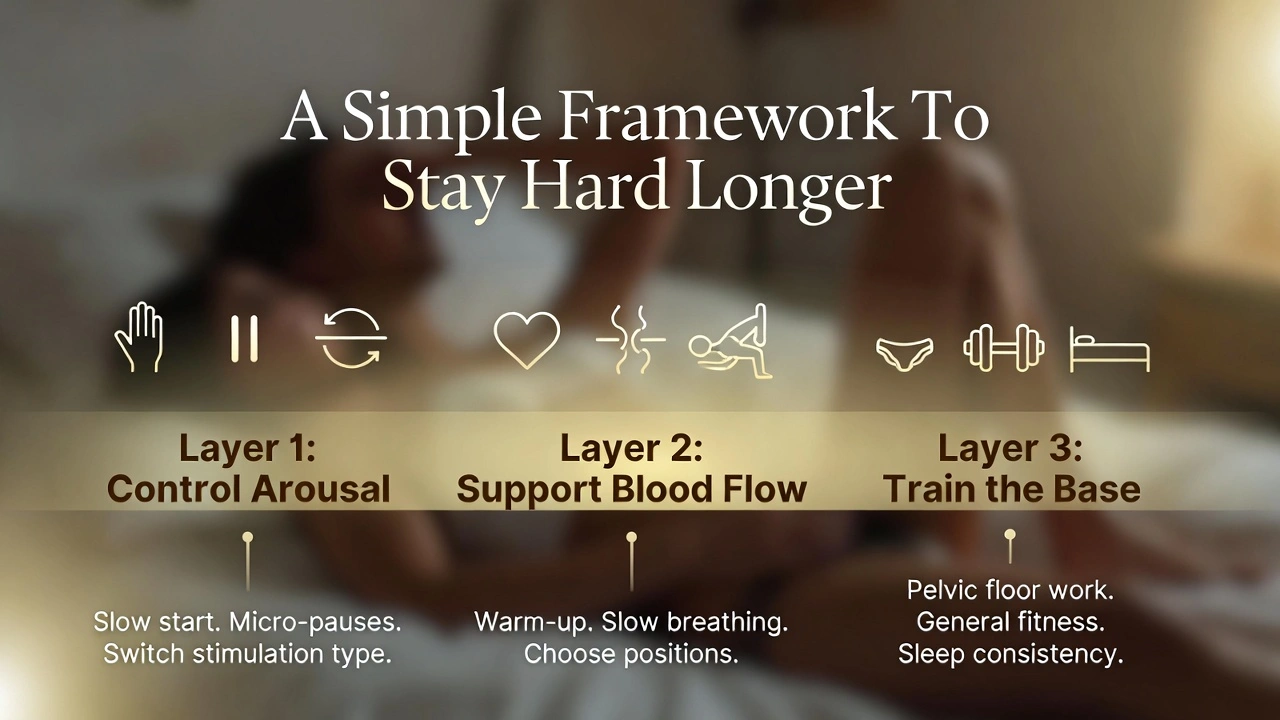
Use this 3-layer approach. It’s simple enough to remember, but powerful enough to change outcomes:
Layer 1 — Control arousal (the “dial”)
- Start slower than you think you should.
- Use “micro-pauses” (5–15 seconds) when you feel yourself racing.
- Switch stimulation type: pressure → rhythm → pause → rhythm.
Layer 2 — Support blood flow (the “engine”)
- Warm-up: a few minutes of kissing/foreplay is not optional if you want reliability.
- Breathing: slow exhale reduces stress response and keeps arousal stable.
- Position choice: some positions are circulation-friendly; others are “fatigue factories”.
Layer 3 — Train the base (the “foundation”)
- Pelvic floor work (done correctly, not compulsively).
- General fitness: walking + a bit of strength is underrated.
- Sleep consistency: boring, but brutally effective.
🔥 The #1 mindset shift
Stop chasing “perfect”. Aim for consistent. Consistency makes your body calm — and calm makes erections stronger.
Comparison table: what to try first (and why) 📊
Here’s a practical “what should I do first?” table. Choose 1–2 actions and stick with them for 2 weeks.
| Method | Best for | How fast it helps | Common mistake |
|---|---|---|---|
| Micro-pauses + slower start | Guys who get hard fast but lose it mid-way | Immediate | Pausing too late (after you already spiked) |
| Breathing (long exhale) | Performance anxiety / “thinking too much” | Immediate | Holding breath during effort |
| Pelvic floor training (balanced) | Softness, poor firmness, endurance problems | 2–6 weeks | Only squeezing, never relaxing |
| Sleep + alcohol reduction | Unreliable erections, low libido | 3–14 days | Trying “techniques” while staying exhausted |
| Position strategy | Staying hard during movement / fatigue | Immediate | Choosing positions that overload legs/core |
Techniques (step-by-step, realistic, not cringe) 🧩
✅ Technique 1: The “30–70 rule” (pacing that keeps you stable)
Most people go 70% intensity at the start, then crash. Flip it: start at 30% intensity for longer than feels necessary, then rise to 70% later. This keeps your nervous system in the “safe arousal” zone longer.
- First 3–5 minutes: slow rhythm + breathe out longer than you breathe in.
- When you feel “I’m rushing”: pause 5–10 seconds, then restart slower.
- Only go hard once you feel stable, not desperate.
✅ Technique 2: Micro-pauses (the easiest upgrade)
You don’t need to stop completely. You just need tiny interruptions that prevent overload. Think of them as “reset breaths” for your arousal.
- Pause movement, keep contact/connection.
- Take 2 slow breaths (especially the exhale).
- Restart gently, build again.
✅ Technique 3: Pelvic floor (strength + release) 🏋️♂️
If you train pelvic floor, do it like a smart athlete: strengthen and learn to relax. A pelvic floor that is always tense can backfire. Balance matters.
“The best control comes from a muscle that can contract and fully let go.” If you only squeeze, you’re training tension — not skill.
A simple weekly routine (beginner-friendly)
- 3 days/week: short sessions (5–8 minutes).
- Do a few controlled squeezes + full relaxation after each.
- Stop if you feel pain, cramping, or increased pelvic tension.
✅ Technique 4: “Erection-friendly” positions (fatigue management)
Sometimes it’s not arousal, it’s fatigue. If your legs/core are burning, blood flow and focus can drop. Choose positions where you’re not doing a full-body workout while trying to stay present.
- If you tend to lose it during intense movement: slow down and reduce load on legs.
- Switch roles / change angle / add pauses so your body doesn’t hit “effort mode”.
✅ Technique 5: “Stop chasing hardness” (paradox that works)
The more you check it, the more you stress it. Try this instead:
- Shift attention to sensation, smell, skin, breathing, connection.
- Let the erection be a result, not a task.
- If it softens: stay calm, slow down, rebuild arousal gradually.
🔗 If you’re exploring long-wear restraint dynamics, comfort matters. A well-fitted option reduces distraction and pressure. Here are
